2.5 years ago I decided to take a step forward and broaden my skillset by diving into AWS and pursuing an AWS Solutions Architect Certification.
2.2 years ago I got certified as an AWS Solutions Architect - Associate.
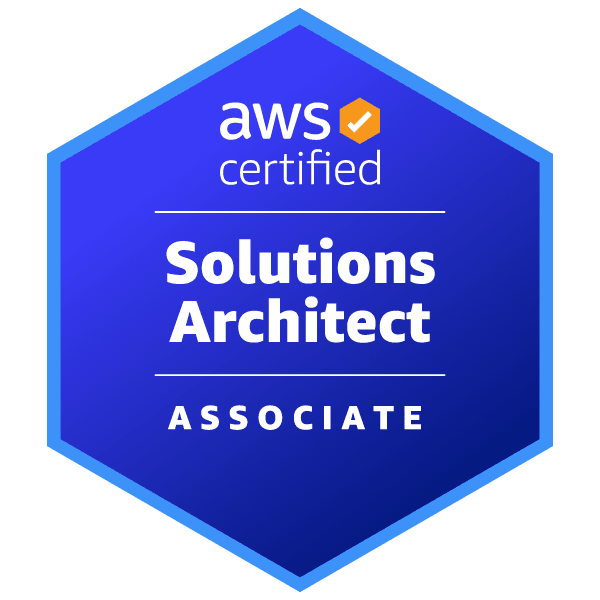 Source: https://www.credly.com/badges/9a8ec203-8e37-459a-888b-aff33aeb1080
After reading this article, you’ll learn:
- what is AWS Certified Solutions Architect – Associate
- how to prepare for the exam
- why might you consider pursuing the certification
- my why for taking the certification
Note:
What is AWS Certified Solutions Architect – Associate?
In this article, we’re talking about AWS Certified Solutions Architect – Associate (SAA-C02). The latest version of this AWS exam is SAA-C03.
It validates the ability to effectively demonstrate knowledge of architecting and deploying secure and robust AWS applications.
The exam covers the following domains:
- Domain 1: Design Secure Architectures (30% of scored content)
- Domain 2: Design Resilient Architectures (26% of scored content)
- Domain 3: Design High-Performing Architectures (24% of scored content)
- Domain 4: Design Cost-Optimized Architectures (20% of scored content)
You can learn more about the exam here: AWS Certified Solutions Architect - Associate (SAA-C03) Exam Guide or on the main page: AWS Certified Solutions Architect - Associate.
Note: SSA-C03 is pretty much similar to SSA-C02. It only differs in the % of scored content per domain and maybe some newly added services.
How to prepare for the exam?
My recommendation would be:
- Ultimate AWS Certified Solutions Architect Associate SAA-C03 course by Stephane Maarek. The course’s structure and content were pretty good. It includes several tests that are similar to the original exam. During the course, you will go through all the AWS services in the exam. Also, you get a PDF with all the slides, so you can revisit them later. I found this helpful because I went through the slides on the morning of the exam. 😄
💡 If some concepts are not clear, dig deeper into them. Make sure the basics are covered.
For example, I found I have some gaps in Networking, so I had to fix them before proceeding with VPC.
- Practice on AWS while going through the course. Most of the stuff you can do for free. The rest, you can found some free credits for AWS that you can use. After creating and setting up some services, make sure to delete them, so you don’t get charged for them.
- Read the User Guides / Developer Guides / FAQs for the main services:
- IAM
- S3
- CloudFront
- EC2
- Lambda
- ELB
- RDS
- VPC
- API Gateway
- DynamoDB, including global tables
- You may also go through the FAQs of the other services included in the Exam, so you have some basic understanding of the problems you can solve with them. For example Route 53, EBS, WAF, VPN CloudHub, Kinesis Streams and Kinesis Firehouse, CloudWatch, CloudTrail, Direct Connect, KMS, Cognito, Organizations, Glue.
- Go through these whitepapers:
- AWS Well-Architected Framework - https://wa.aws.amazon.com/index.en.html
- make sure to go through the Six Pillars: Operational Excellence, Security, Reliability, Performance Efficiency, Cost Optimization, Sustainability.
- AWS Disaster Recovery Whitepaper
- you can also read some other whitepapers like AWS Security Whitepaper, AWS Store Optinos Whitepaper, AWS VPC Connectivity Whitepaper, etc.
- Start doing practice exams on Whizlabs: https://www.whizlabs.com/aws-solutions-architect-associate/
- After each practice exam, repeat 1-6, so you fill in the gaps and missing information.
- Aim for at least an 80%-90% score on the practice exams, so you have strong confidence for the real one.
- Take the exam 💪
💡 Tip: If you’re a non-English speaker, you may request an additional 30 minutes for the exam.
Why might you consider pursuing the certification?
- Job Search and Visibility - you might increase your chances of getting a job if you have this certification
- Learning more about Software Architecture and AWS - you want to get better at designing systems at scale, especially with AWS
Focus on the transferable knowledge and fundamentals. So even if you stop using AWS, the acquired knowledge will be helpful since all Cloud Providers have similar services and principles.
- Credibility - If you’re working in a consulting company, having this certification might help to close new clients. And at least, you’ve proved you know something about AWS.
Note: Nothing can beat the hands-on experience, but combining it will the certification will be a strong value prop.
My Why of taking the certification?
- Get better at designing and architecture software applications and systems
- Fill knowledge gaps
- Understanding the big picture of how today’s applications and systems operate
- Advance as a Software Engineer and move a step closer to the Software Architecture role
- Get a basic understanding of what AWS can offer
- Get more hands-on experience on AWS
- Curiosity and learning
💡 Note: I timeboxed the learning and practice, so it doesn't spill out in time. I think this played well since it kept me focused.
📚 References:
- Do you need certifications by The Hustling Engineer, Hemant Pandey
- AWS Certified Solutions Architect - Associate (SAA-C03) Exam Guide
- AWS Certified Solutions Architect – Associate SAA-C02 Exam Learning Path
- Architecting for the Cloud – AWS Best Practices – Whitepaper – Certification
- AWS VPC Core Concepts in an Analogy and Guide
- Ultimate AWS Certified Solutions Architect Associate SAA-C03 (Udemy Course)
- AWS Certified Solutions Architect Associate (Whizlab’s Practice Tests)